Missed delivery windows are not just delays. They lead to customer complaints, repeat delivery attempts, and pressure on your operations team.
When this starts happening daily, it is not a one-off issue. It is a sign that your routing system is not keeping up with real conditions.
Many delivery businesses still depend on manual planning or fixed routes. These methods cannot respond to traffic changes, urgent orders, or shifting delivery priorities. And as your volume grows, these limitations directly affect your on-time delivery rate.
If you are trying to improve delivery performance, the focus needs to shift from effort to systems.
AI route optimization helps you plan, adjust, and execute routes based on real-time data, not assumptions.
In this article, you will learn how AI route optimization improves on-time delivery and brings consistency to your operations.
Let’s begin with understanding the meaning!
What Is AI Route Optimization in Delivery Operations?
AI route optimization is a system that plans and continuously adjusts delivery routes using real-time data such as traffic, delivery priority, driver location, and time windows.
Its goal is simple: ensure deliveries are completed in the most efficient sequence while meeting promised time commitments.
Unlike traditional routing, which creates a fixed plan at the start of the day, AI-powered route optimization keeps updating routes during execution.
If traffic conditions change or a new high-priority order is added, the system recalculates the route instantly.
Traditional Routing vs AI-Based Route Optimization
| Aspect | Traditional Routing | AI Route Optimization |
|---|---|---|
| Route Planning | Static | Dynamic |
| Traffic Handling | Limited | Real-time |
| Delivery Prioritization | Manual | Automated |
| Adaptability | Low | High |
This shift from static to dynamic planning is what directly improves on-time delivery performance.
How AI Route Optimization Works in Simple Terms
Here’s the simple process:
-
Collects real-time data from multiple sources
-
Calculates the most efficient delivery sequence
-
Assigns routes based on current conditions
-
Continuously adjusts routes during delivery
For example, if traffic increases on a planned route, the system suggests an alternative path. If a high-priority delivery is added, it adjusts the sequence automatically.
In simple terms, AI route optimization software does not just plan routes. It manages them throughout the day to keep your deliveries on track.
Why Courier and Delivery Businesses Struggle With On-Time Deliveries
Understanding the root causes of delays is essential before looking at solutions. Here are the most common causes of delivery delays:
The Most Common Causes of Delivery Delays
Most delivery delays come from operational gaps, not external factors:
-
Inefficient route planning that ignores real-world conditions
-
Manual dispatch decisions based on experience rather than data
-
Lack of real-time updates during delivery
-
Poor sequencing of deliveries
When routes are planned manually, they often follow logical assumptions rather than actual conditions. This leads to unnecessary travel and missed time windows.
Additionally, the hidden cost of late deliveries include:
| Impact Area | Business Effect |
|---|---|
| Customer Experience | Low satisfaction and reduced trust |
| Operations | Re-delivery attempts increase workload |
| Cost | Higher fuel usage and driver hours |
| Contracts | SLA penalties and lost partnerships |
Late deliveries do more than delay one order. They disrupt the entire operation.
-
Drivers spend more time on the road
-
Fuel costs increase, and
-
Customer confidence drops
Expert Tip:
If your team frequently adjusts routes manually during the day, it is a sign your system lacks real-time optimization.
How AI Route Optimization Directly Improves On-Time Delivery Rates
AI route optimization is the core of your delivery performance.
-
If your routes are inefficient, delays are inevitable.
-
If your system cannot adapt during the day, even a well-planned route will fail.
To improve on-time delivery, you need to fix how routes are planned, executed, and adjusted in real time. This is exactly what AI route optimization changes in your operations.
Let’s see how:
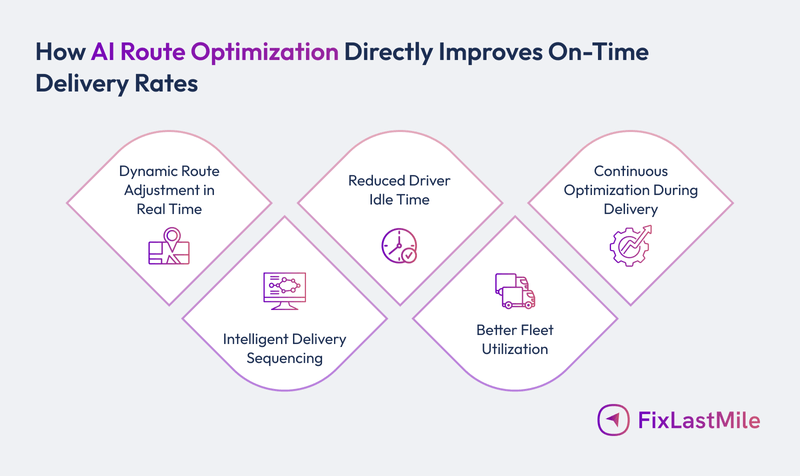
1. Dynamic Route Adjustment in Real Time
When you rely on static routing, your plan becomes outdated the moment drivers hit the road. Traffic builds up, roads slow down, and delays start forming.
With AI route optimization, routes are not fixed. They are continuously updated.
-
If traffic increases, the route is adjusted
-
If delays occur, the system recalculates instantly
-
If a better path becomes available, it is applied
This means you are not reacting after delays happen. You are preventing them before they affect delivery timelines.
2. Intelligent Delivery Sequencing
One of the biggest reasons for missed delivery windows is poor sequencing. Deliveries are often arranged in a way that looks logical on a map but fails in execution.
AI changes this by sequencing deliveries based on:
-
Time windows
-
Order urgency
-
Distance and route flow
Instead of treating all deliveries equally, the system ensures that time-sensitive orders are completed first.
For you, this directly improves on-time delivery rates, especially for priority deliveries.
3. Reduced Driver Idle Time
Delays are not always caused by long distances. They often come from inefficiencies.
Drivers wait for instructions. They pause between deliveries. They take longer routes than necessary. These small gaps reduce overall efficiency.
With AI-powered route optimization, your drivers operate with clarity:
-
Routes are pre-optimized
-
No waiting for dispatch updates
-
No unnecessary stops
Drivers move continuously, which reduces idle time and keeps deliveries on schedule.
4. Better Fleet Utilization
If your routes are not optimized, your fleet is underutilized. Some drivers are overloaded while others are underused. This imbalance creates delays.
AI ensures balanced workload distribution:
-
Deliveries are assigned efficiently
-
Routes are structured to maximize output
-
Each driver handles an optimal number of deliveries
This allows you to complete more deliveries within the same shift without increasing pressure on your team.
5. Continuous Optimization During Delivery
Most systems stop optimizing after route planning. This is where they fail.
Real-world delivery conditions change constantly. Without continuous adjustment, even a good plan becomes inefficient.
With AI route optimization software, optimization does not stop:
-
Routes are recalculated throughout the journey
-
Delivery sequences are updated dynamically
-
Drivers are guided based on live conditions
This ensures that your operations remain stable even when conditions are unpredictable.
AI vs Manual Routing: What Actually Changes in Daily Operations
If you want to improve on-time delivery, you need to look at what actually happens during the day, not just how routes are planned.
The difference between manual routing and AI route optimization becomes clear when you compare daily execution:
| Operation Area | Without AI | With AI Route Optimization |
|---|---|---|
| Route Planning | Manual and time-consuming | Automated and efficient |
| Dispatch Decisions | Experience-based | Data-driven |
| Delivery Time Accuracy | Low and inconsistent | High and predictable |
| Driver Productivity | Variable | Optimized |
| On-Time Delivery Rate | Unstable | Consistent |
With manual routing, your team spends time fixing problems as they appear.
With AI-powered route optimization, your system prevents most of those problems before they impact delivery timelines.
Key Features That Enable AI Route Optimization
To understand how AI route optimization improves delivery performance, you need to look at the features that drive it. They are:
Real-Time Traffic Integration
Your routes are adjusted based on live traffic conditions, not assumptions made at the start of the day. This helps you avoid congestion, reduce delays, and keep deliveries moving on schedule.
Smart Dispatch Allocation
Orders are assigned automatically to the most suitable driver based on location, availability, and route efficiency. This removes delays caused by manual assignment and improves response time.
Multi-Stop Route Planning
The system groups multiple deliveries into optimized routes, ensuring logical sequencing and minimal travel distance. This helps your drivers complete more deliveries within the same shift.
Delivery Time Window Management
Time-sensitive deliveries are prioritized based on defined delivery slots and urgency. This ensures critical orders are completed within the promised timeframe.
Live Tracking and Re-Routing
Routes are continuously monitored and adjusted during execution. If conditions change, the system recalculates instantly to maintain delivery efficiency and timing.
How to Implement AI Route Optimization in Your Delivery Business
Improving on-time delivery requires more than adopting a new tool. You need to rethink how your routing and dispatch decisions are made across the day.
Implementing a structured approach ensures that AI route optimization fits into your operations and delivers measurable results from the start.
Here are the clear steps:
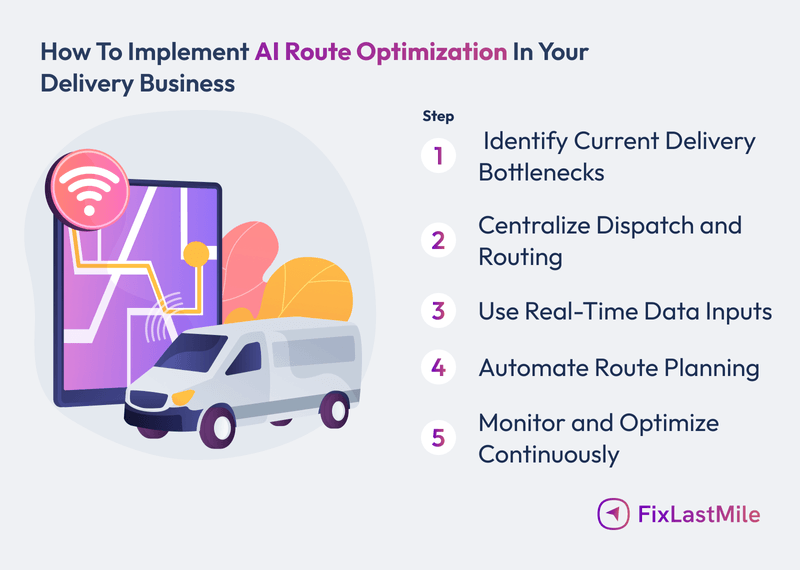
Step 1: Identify Current Delivery Bottlenecks
Start by reviewing where delays actually occur. Look at route planning, dispatch timing, delivery sequencing, and driver idle time. This gives you a clear baseline to improve.
Step 2: Centralize Dispatch and Routing
Move away from scattered tools and manual coordination. Bring your routing and dispatch into a single system so decisions are consistent and visible.
Step 3: Use Real-Time Data Inputs
Ensure your system uses live data such as traffic conditions, driver location, and order updates. This is essential for dynamic route adjustments.
Step 4: Automate Route Planning
Let the system generate optimized routes instead of relying on manual planning. This reduces errors and improves efficiency across deliveries.
Step 5: Monitor and Optimize Continuously
Track performance using delivery analytics. Identify patterns, measure improvements, and refine your routing strategy over time.
This approach helps you implement last mile delivery optimization effectively.
What to Look for in an AI Route Optimization Software
When selecting software, focus on capabilities that support real operations:
-
Real-time routing capability
-
Dynamic dispatch
-
Delivery analytics
-
Scalability for growing operations
Avoid solutions that only provide static route planning. Look for systems designed for real-time execution.
Conclusion
As your delivery volume grows, maintaining consistent on-time delivery becomes difficult if your system depends on manual planning or fixed routes.
Delays start repeating, customer expectations are missed, and your team shifts into reactive mode. At that point, adding more effort does not solve the problem. The system itself needs to change.
AI route optimization addresses this at the core.
It plans routes intelligently, adapts in real time, and ensures deliveries follow the most efficient sequence. This brings control, consistency, and predictability to your operations.
If you are serious about improving delivery performance, you need a system built for real-world conditions.
FixLastMile’s AI-powered delivery route optimization software is designed to handle dynamic routing, smart dispatch, and continuous optimization in one place. It helps you reduce delays, improve efficiency, and maintain high on-time delivery rates.
The next step is simple. Review your current routing process and see how a system like FixLastMile can transform your delivery operations.
Improve your on-time delivery with FixLastMile’s AI route optimization built for real delivery operations.
FAQs
AI route optimization uses real-time data like traffic, delivery priority, and driver location to plan and adjust routes dynamically. It ensures deliveries follow the most efficient sequence, helping reduce delays and improve on-time delivery performance.
It improves on-time delivery by adjusting routes in real time, prioritizing time-sensitive orders, and reducing idle time. This ensures deliveries are completed in the right sequence, even when traffic or conditions change during the day.
Yes, by optimizing routes and minimizing unnecessary travel, AI reduces fuel usage and driver idle time. It also lowers failed delivery attempts, which helps reduce overall operational costs while improving delivery efficiency.
Look for real-time routing, dynamic dispatch, driver tracking, delivery analytics, and scalability. These features ensure the system can adapt to changing conditions and support your delivery operations as they grow.