And when you commit to delivering medications within a defined time window, you are agreeing to a Service Level Agreement (SLA). If a delivery arrives late or fails to meet the agreed service conditions, it becomes an SLA violation.
For healthcare logistics teams, SLA compliance is not just an operational metric. Delays can affect medication access, disrupt pharmacy operations, and create compliance risks.
So, as delivery volumes increase and patient expectations rise, maintaining consistent performance becomes more challenging.
However, many healthcare logistics operations still rely on manual dispatch processes, static route planning, and limited delivery visibility. These factors often contribute to delays that lead to missed delivery commitments.
The good news is that SLA violations are preventable.
By improving planning, increasing delivery visibility, and using structured delivery management processes, you can significantly improve reliability.
In this guide, you will learn what causes SLA violations in pharmaceutical deliveries and the practical steps you can take to reduce delivery delays, improve SLA compliance, and strengthen your healthcare logistics operations.
Let’s get straight into it!
What Are SLA Violations in Pharmaceutical Deliveries?
SLA violations in pharmaceutical deliveries are failures to meet the service standards defined in a Service Level Agreement (SLA) for delivery operations.
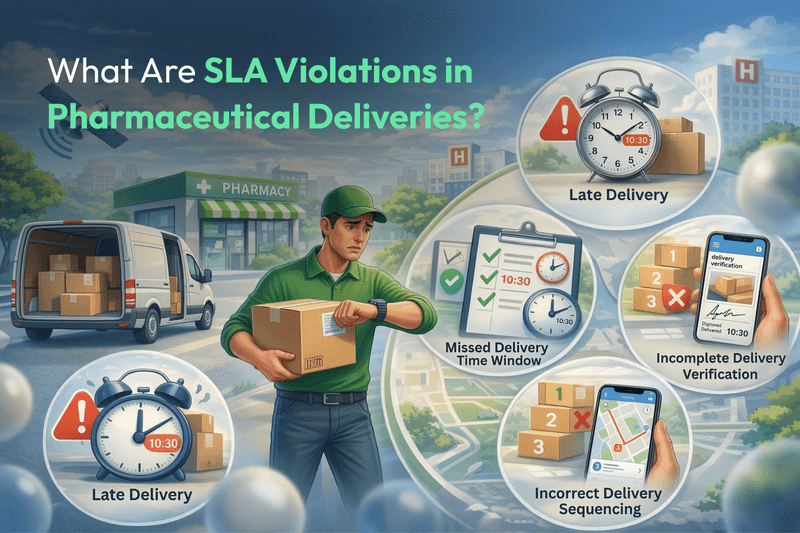
In pharmaceutical logistics, these service standards usually define expectations such as:
-
Delivery timeframes
-
Medication handling requirements
-
Proof of delivery confirmation
-
Service reliability expectations
Service Level Agreements are used by pharmacies, hospitals, and healthcare organizations to ensure that medications are transported safely, delivered on time, and verified properly.
For example, a pharmacy may require prescription deliveries to reach patients within a specific time window. A hospital may require urgent medication shipments to arrive within a defined delivery timeframe.
Common examples of pharmaceutical delivery SLA violations include:
-
Late delivery of prescription medication
-
Missed delivery time windows
-
Incorrect delivery sequencing
-
Incomplete delivery verification
These issues can affect operational performance and service reliability. Healthcare organizations rely on logistics partners that can consistently meet delivery commitments. When delays occur frequently, it can impact trust and operational efficiency.
This is why reducing SLA violations in pharma deliveries has become a priority for healthcare logistics teams.
Why SLA Violations Are Common in Pharma Logistics?
SLA violations are common in pharmaceutical logistics because you often have to manage strict delivery timelines while dealing with manual routing, limited delivery visibility, inefficient dispatch coordination, and complex delivery requirements.
These operational challenges make it difficult for you to consistently meet the service standards defined in healthcare delivery agreements.
In many pharmaceutical delivery operations, delays rarely happen because of one single issue. Instead, they usually occur when several operational gaps affect your delivery workflow.
Below are some of the most common reasons.
Manual Route Planning
If your delivery routes are planned manually, dispatch teams often assign delivery stops based on experience rather than optimized routing calculations.
When this happens, drivers may follow inefficient delivery sequences and travel longer routes than necessary. As a result, delivery times increase and the risk of missing SLA commitments becomes higher.
Using optimized delivery routing can help you improve delivery efficiency for time-sensitive pharmaceutical shipments.
Limited Delivery Visibility
When you do not have real-time delivery tracking, it becomes difficult to see where your drivers are during active deliveries.
If delays occur because of traffic conditions or route disruptions, your operations team may not know about the issue until the delivery window has already been missed.
Limited visibility reduces your ability to take proactive action and prevent SLA breaches.
Inefficient Dispatch Processes
Manual dispatching can slow down your delivery operations.
When delivery assignments are handled manually, it takes longer to allocate delivery jobs to drivers. This delay during the dispatch stage consumes valuable delivery time and increases the chances of missing SLA commitments.
Automated dispatch systems help you assign deliveries faster and improve operational coordination.
Complex Delivery Requirements
Pharmaceutical deliveries are more complex than standard parcel deliveries. In many cases, you may have to manage:
-
Multiple delivery stops
-
Urgent prescription deliveries
-
Strict delivery time windows
-
Sensitive medication handling requirements
Managing these requirements manually increases the chances of operational errors.
Lack of Delivery Performance Monitoring
If you do not consistently monitor delivery performance, recurring operational problems can go unnoticed.
Without performance data, it becomes difficult for you to identify patterns such as:
-
Frequently delayed delivery routes
-
Overloaded drivers
-
Inefficient delivery zones
Tracking delivery performance metrics helps you improve SLA compliance and delivery reliability.
Expert Tip
If you frequently experience delivery delays, review your delivery zone design and route density.
Many SLA violations occur when too many stops are assigned within unrealistic delivery windows. When you segment delivery zones and balance driver workloads more effectively, you can significantly improve pharmaceutical delivery SLA performance.
Operational Risks of SLA Violations in Healthcare Deliveries
SLA violations are not only operational challenges. They can also create broader risks for healthcare logistics operations. They are:
Patient Care Impact
Timely medication delivery plays an important role in patient treatment. And when prescriptions arrive late, it can interrupt treatment schedules or delay access to necessary medication.
Therefore, healthcare organizations prioritize delivery partners who can consistently meet delivery timelines.
Compliance Challenges
Pharmaceutical deliveries often require documented proof of delivery (POD) and proper handling procedures.
If deliveries are delayed or improperly documented, it can create compliance concerns for pharmacies and healthcare providers.
Maintaining reliable pharmaceutical delivery operations helps reduce these risks.
Loss of Operational Trust
Pharmacies and healthcare providers depend on logistics partners that can deliver consistently.
Repeated delivery delays may lead organizations to reconsider their logistics partnerships.
On bright side, reliable delivery performance strengthens long-term relationships with healthcare clients.
Financial Consequences
SLA violations can sometimes lead to service penalties or contract disputes.
Even when financial penalties are not involved, frequent delays can result in lost contracts and reduced business opportunities.
Improving SLA compliance in pharma logistics helps protect operational stability.
5 Proven Ways to Reduce SLA Violations in Pharma Deliveries
Reducing SLA violations requires structured operational improvements.
By improving planning, delivery monitoring, and dispatch coordination, you can significantly improve delivery reliability.
Here are five strategies that healthcare logistics teams use to improve pharmaceutical delivery performance.
1. Implement Route Optimization for Time-Sensitive Deliveries
One of the most effective ways to reduce delivery delays is by usingroute optimization software.
Route optimization systems automatically calculate the most efficient delivery routes based on factors such as:
-
Delivery locations
-
Traffic conditions
-
Delivery time windows
-
Driver schedules
Instead of relying on manual planning, optimized routes help drivers follow the most efficient delivery path.
Benefits of route optimization in pharma deliveries include:
-
Reduced travel time
-
Improved delivery sequencing
-
Higher on-time delivery rates
When routes are optimized, drivers can complete more deliveries within SLA timeframes.
2. Enable Real-Time Driver Tracking
Real-time visibility plays a critical role in managing delivery operations.
With real-time driver tracking, dispatch teams can monitor driver locations during delivery routes.
This visibility allows operations teams to:
-
Identify delays early
-
Adjust delivery plans when necessary
-
Communicate with drivers more effectively
For example, if traffic conditions slow down a driver, dispatch teams can reroute deliveries or adjust schedules to prevent SLA breaches.
Real-time monitoring improves operational responsiveness and helps maintain delivery commitments.
3. Automate Dispatch and Delivery Assignment
Manual dispatch processes often create delays before deliveries even begin.
By implementing automated dispatch systems, delivery assignments can be generated instantly based on predefined rules such as:
-
Driver availability
-
Delivery location
-
Workload balancing
Automation reduces the time required to assign deliveries and ensures drivers begin their routes quickly.
Faster dispatch coordination helps reduce the risk of missing delivery time windows.
4. Use Digital Proof of Delivery
Healthcare deliveries require reliable delivery verification.
Digital proof of delivery (POD) allows drivers to confirm deliveries using:
-
Electronic signatures
-
Delivery photos
-
Timestamp verification
This information provides clear documentation that deliveries were completed according to the service agreement.
Proof of delivery also helps resolve delivery disputes and maintain compliance records for pharmaceutical shipments.
5. Monitor SLA Performance with Delivery Analytics
Tracking delivery performance helps logistics teams identify operational improvements.
Using delivery analytics tools, you can monitor important metrics such as:
-
On-time delivery rates
-
Average delivery duration
-
Route efficiency
-
Driver productivity
These insights help identify recurring operational issues and improve future delivery planning.
Continuous performance monitoring allows you to refine operations and maintain consistent SLA compliance in healthcare logistics.
Expert Tip:
Track on-time delivery rates by route and driver, not just overall performance. When delays are analyzed at a granular level, you can quickly identify specific routes or operational bottlenecks that contribute to recurring SLA violations.
How Delivery Technology Helps Prevent SLA Breaches
As pharmaceutical delivery networks expand, managing operations manually becomes increasingly difficult.
Modern last-mile delivery management platforms provide tools that help logistics teams coordinate deliveries more effectively.
These platforms often include features such as:
-
Route optimization for delivery planning
-
Automated dispatch systems
-
Real-time driver tracking
-
Delivery performance analytics
-
Digital proof of delivery tools
With these capabilities, healthcare logistics teams can improve delivery coordination, monitor driver activity, and quickly respond to operational disruptions.
From this instance, it can be said that - Technology does not replace operational expertise, but it provides the visibility and automation required to maintain reliable delivery performance.
For organizations managing complex delivery networks, structured delivery management systems can play an important role in reducing SLA violations in pharmaceutical deliveries.
Conclusion
Reducing SLA violations in pharma deliveries requires better visibility, smarter planning, and structured delivery coordination.
When you optimize routes, track drivers in real time, automate dispatch, and monitor delivery performance, you can significantly improve on-time pharmaceutical deliveries and maintain reliable service for pharmacies and healthcare providers.
Consistent SLA performance strengthens operational efficiency and builds trust with healthcare partners who rely on dependable delivery services.
At FixLastMile, we help you simplify complex delivery operations with tools like route optimization, real-time driver tracking, automated dispatch, and delivery analytics.
With the right delivery management platform, you can reduce delays, improve SLA compliance, and run more reliable pharmaceutical delivery operations.
Reduce pharma delivery delays and improve SLA performance using FixLastMile’s intelligent last mile delivery solution.
FAQs
Common causes include manual route planning, inefficient dispatch operations, lack of real-time delivery tracking, and complex delivery requirements for medications.
Route optimization calculates the most efficient delivery routes, helping drivers complete deliveries faster and reducing the likelihood of missed delivery deadlines.
Real-time tracking allows dispatch teams to monitor delivery progress and respond quickly to delays before they result in SLA violations.
Proof of delivery provides verified documentation that medications were delivered successfully, helping ensure compliance and improve delivery transparency.
Delivery technology improves route planning, tracking, and dispatch automation, helping logistics teams complete pharmaceutical deliveries on time and avoid SLA breaches.