Your deliveries are getting delayed, even though you can see every driver moving in real time. That is where most delivery operations start to feel the gap.
You invest in driver tracking software, open the live dashboard, and track every route. On the surface, everything looks visible. But delays still happen. Drivers are not always assigned efficiently. Dispatch teams still make last-minute decisions under pressure.
The problem is not visibility. It is the assumption that visibility equals control.
Driver tracking tells you where your driver is. It does not tell you what should happen next or how well your operations are performing.
That is where driver management becomes critical.
In this article, you will understand the real difference between driver tracking and driver management, the mistakes most delivery businesses make, and how to move toward a system that actually improves delivery outcomes.
Let’s get into it!
Why Delivery Operations Still Break Down Even After Tracking Drivers
Before you improve your system, you need to understand why live visibility alone does not solve deeper operational problems.
The Illusion of Visibility
When you implement delivery driver tracking, your team gets access to a real-time map, route movement, and current driver location. This creates a strong feeling of operational awareness. Everyone can see movement. Everyone can check their status. It seems like the business now has control.
But visibility is not the same as control.
Tracking answers one narrow question. It tells you where the driver is at a specific moment. It does not explain whether the driver was assigned efficiently, whether the route is the best one, whether the delivery should have been reassigned, or whether the same delay pattern keeps repeating with the same driver.
That is why many delivery teams become overconfident after adopting tracking tools. The dashboard looks active, but the operation still behaves in a reactive way.
Common Operational Gaps
Even with live tracking in place, the same delivery problems often continue:
-
Late driver assignment
-
Idle drivers during busy hours
-
Uneven workload across the fleet
-
No clear accountability for missed deliveries
-
No structured driver performance tracking
-
Slow dispatch decisions under pressure
These issues remain because tracking only shows activity. It does not guide execution.
If your team still depends on manual judgment for assignment, reallocation, performance review, and operational correction, then tracking is only giving you a better window into the problem. It is not fixing the system behind it.
Visibility without control creates false confidence.
| Operational Need | Tracking Alone | Management System |
|---|---|---|
| See driver location | Yes | Yes |
| Assign drivers intelligently | No | Yes |
| Measure performance | Limited | Yes |
| Improve SLA consistency | Reactive | Proactive |
| Reduce manual effort | No | Yes |
Expert Tip: If your dispatcher spends more time watching the map than improving delivery flow, your system is informing the team but not empowering it.
What Is Driver Tracking in Delivery Operations?
Driver tracking is the process of monitoring driver location through GPS or mobile-based systems in real time. It is mainly designed to provide visibility into driver movement during delivery operations.
This makes it useful, but limited.
What Driver Tracking Actually Does
A standard driver tracking system usually helps you:
-
View the current location of a driver
-
Monitor route movement
-
Check whether a delivery is in progress
-
Share basic status with dispatch teams or customers
-
Review simple location history
These features matter. They improve transparency. They help teams know where things stand. They also support customer communication when someone wants to know where the order is.
So tracking is not unimportant. It is necessary.
Where Driver Tracking Falls Short
The problem starts when businesses expect tracking to do more than it is built for.
Tracking does not:
-
Measure driver efficiency in a meaningful way
-
Improve task allocation on its own
-
Predict delays before they affect delivery timelines
-
Compare driver performance across time
-
Reduce dispatcher dependency
-
Control execution quality from assignment to completion
In other words, tracking is a visibility layer, not a performance system.
This is why many businesses that rely only on delivery tracking software remain reactive. They can spot a delay once it appears, but they cannot consistently prevent it, correct patterns, or improve operational outcomes across the fleet.
What Is Driver Management? A System, Not Just a Feature
Driver management is a structured operational system that helps you assign, monitor, control, evaluate, and improve driver activity across your delivery workflow.
It is not one feature. It is not one dashboard. It is an operating layer that connects planning and execution.
Instead of only asking where the driver is, driver management asks better questions:
-
Was the right driver assigned?
-
Is workload balanced?
-
Is the route being executed efficiently?
-
Is this driver consistently reliable?
-
What changes should improve future performance?
That is why driver management software creates stronger outcomes than location visibility alone.
Core Components of Driver Management
A complete driver management system often includes:
-
Smart driver assignment based on proximity, workload, and delivery urgency
-
Real-time status monitoring
-
Structured driver performance tracking
-
Task execution oversight
-
Proof of delivery collection
-
Delivery completion logs
-
Historical performance review
-
Reassignment support when conditions change
These components work together. That matters because delivery operations do not fail at one point only. They fail when decisions are disconnected.
Driver management connects planning, execution, and continuous improvement into one operational system.
Driver Management vs Driver Tracking: Key Differences That Impact Operations
Now the distinction becomes easier to see in direct terms.
Below is a simple comparison that shows why these two ideas should never be treated as the same thing.
| Aspect | Driver Tracking | Driver Management |
|---|---|---|
| Primary purpose | Location visibility | Operational control |
| Main focus | Where the driver is | How the driver performs |
| Capability | GPS and movement updates | Assignment, monitoring, performance, proof |
| Decision-making value | Limited | High |
| SLA impact | Mostly reactive | Proactive |
| Operational scope | Narrow | End to end |
| Scalability | Low to moderate | High |
| Dispatcher dependency | Still high | Reduced |
| Accountability | Weak | Strong |
| Improvement potential | Minimal | Continuous |
What Most Delivery Businesses Get Wrong
This is where the operational misunderstanding becomes expensive.
Mistake 1: Assuming Tracking Solves Delays
A tracking tool can show that a driver is late. It cannot stop that driver from being late in the first place.
This matters because many businesses believe visibility automatically improves timing. It does not. A delay seen late is still a delay. If the system did not assign properly, optimize workload, or support proactive adjustment, the map simply confirms the problem after it has already started.
Mistake 2: Ignoring Driver Performance Metrics
Without structured driver performance tracking, you do not really know which drivers are reliable, which ones take longer than expected, which ones struggle in certain delivery zones, or which ones consistently meet timelines.
That creates blind spots in management.
You may keep assigning work evenly even when performance is uneven. You may assume delivery issues come from routes or traffic when the real issue is execution quality.
Mistake 3: Combining Manual Dispatch with Tracking
Businesses implement tracking, but continue using manual assignment methods. The dispatcher watches the map, checks availability, and decides what to do next. That may work at very low volume, but as operations grow, it creates bottlenecks.
The dispatcher becomes the system.
That leads to slower assignment, inconsistent decision-making, and preventable inefficiency.
Mistake 4: No Accountability Framework
If your system does not keep proper delivery logs, task records, proof of completion, and performance history, then there is no reliable way to improve.
Problems repeat because the business cannot study them properly.
A missed delivery becomes a one-off incident instead of a measurable pattern. Poor driver performance goes unnoticed. Operational reviews stay subjective.
Most delivery businesses optimize visibility, but the real need is execution quality.
Expert Tip:
The moment your delivery volume grows faster than your dispatch team’s ability to make decisions manually, tracking stops being enough.
How to Move from Driver Tracking to Driver Management
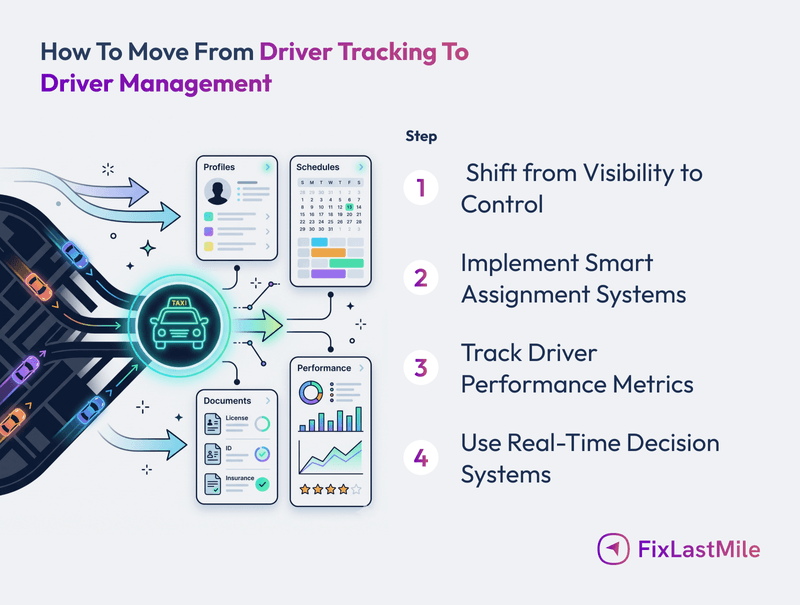
Once the gap is clear, the next step is transition.
Step 1: Shift from Visibility to Control
Start by changing what success means.
Do not measure success by how much data your team can see. Measure success by whether deliveries are assigned properly, completed on time, and improved over time.
This mindset shift matters because many teams still confuse dashboards with operational maturity.
Step 2: Implement Smart Assignment Systems
Use systems that support driver allocation based on real operating needs such as:
-
Location
-
Availability
-
Workload
-
Delivery urgency
-
Route logic
This reduces dispatcher pressure and improves decision consistency.
Step 3: Track Driver Performance Metrics
Build performance visibility around useful measures, such as:
-
On-time delivery rate
-
Task completion consistency
-
Average delivery efficiency
-
Failed or delayed delivery patterns
-
Zone-wise driver performance
This is what turns data into operational improvement.
Step 4: Use Real-Time Decision Systems
Real-time systems should do more than show status. They should support action.
That includes:
-
Dynamic reassignment
-
Proactive intervention
-
Better dispatcher recommendations
-
Faster response to exceptions
This is where platforms like FixLastMile become relevant. A system like this helps businesses move beyond basic driver tracking by combining assignment, execution visibility, proof of delivery, and driver performance tracking into one operational flow.
That kind of structure is what supports scale.
Conclusion
If your delivery operations still rely only on driver tracking software, you are working with visibility, not control. You can see every driver and every delay, but you still cannot influence outcomes consistently.
That is why inefficiencies continue even when your system appears active.
Driver management is what closes this gap. It connects assignment, execution, and performance into a structured workflow, helping you prevent issues instead of reacting to them.
This directly improves on-time delivery, reduces operational cost, and creates consistency across your operations.
If you are serious about improving delivery performance, you need a system built for execution, not just tracking.
FixLastMile delivers this through its driver management capabilities, where assignment, tracking, performance monitoring, and proof of delivery work together, giving you full control over how drivers operate and how deliveries get completed.
Turn driver chaos into controlled, on-time deliveries with FixLastMile’s driver management system today
FAQs
Driver tracking shows real-time location of drivers, while driver management controls assignment, performance, and execution. Tracking provides visibility, but management ensures efficiency, accountability, and better delivery outcomes.
Driver tracking software only shows where drivers are. It does not optimize routes, assign tasks intelligently, or measure performance. Without management, operations remain reactive and delays continue despite full visibility.
Driver management systems improve delivery performance by automating assignment, tracking driver efficiency, and enabling real-time decisions. This leads to better resource use, higher on-time rates, and reduced operational delays.
A strong driver management system should include smart assignment, real-time tracking, performance monitoring, proof of delivery, and analytics. These features help control operations and improve delivery consistency at scale.
You should move to driver management software when delivery volumes grow, delays increase, and manual dispatch becomes inefficient. It helps shift from reactive tracking to proactive control and better operational outcomes.