Pharma delivery operations are under pressure. Order volumes are rising, delivery timelines are shrinking, and compliance expectations are stricter than ever.
What worked when you handled 30 to 50 deliveries a day will not hold when that number reaches 200 or more.
If your current system relies on manual dispatch, phone calls, or spreadsheets, scaling will expose its limits quickly. Delays increase, errors multiply, and your team spends more time fixing issues than managing operations.
A scalable pharma delivery operation is not built by adding more drivers or dispatchers. It is built by creating a structured pharmacy delivery software/system that handles growth without increasing complexity.
This guide explains how you can design such a system. You will learn what breaks at scale, what components you need, and how to build a delivery operation that remains fast, compliant, and predictable as volume grows.
Let’s get started!
Why Scalability Matters in Pharma Delivery
Before building a scalable system, you need to understand what scalability actually means in this context.
What “Scalable Pharma Delivery” Actually Means
Scalability is the ability to increase delivery volume without losing control over execution. In pharma delivery, this translates into three critical capabilities:
-
Handling more orders without increasing delays
-
Maintaining consistent SLA performance across all deliveries
-
Ensuring compliance and documentation at every stage
If any of these fail, your operation is not scalable. Growth without control leads to operational instability.
Scalable Pharmacy Delivery Operations
Scalable pharma delivery operations are systems that allow pharmacies to increase delivery volume while maintaining speed, accuracy, and compliance without adding operational complexity.
The Real Challenges That Break Pharma Delivery Operations
To build a scalable system, you must first identify what typically causes operations to fail. The real challenges that break pharma delivery operations are:
Delivery Delays and Missed SLAs
Delays usually originate from two sources:
-
Inefficient route planning
-
Manual dispatching
When routes are not optimized, drivers take longer paths and miss delivery windows. And when dispatching is manual, assignment delays create bottlenecks. These issues compound as volume increases.
Lack of Real-Time Visibility
Without a centralized tracking system:
-
Admin teams cannot monitor delivery progress
-
Customers remain uninformed about their orders
This results in frequent support calls and reduced customer trust. So, here visibility is not optional at scale. It is essential for control.
Compliance and Audit Risks
Pharma delivery requires strict documentation. Common risks include:
-
Missing proof of delivery
-
Incomplete or inconsistent records
These gaps create audit failures and expose your business to regulatory issues.
Operational Bottlenecks at Scale
As delivery volume grows, manual systems become inefficient:
-
Spreadsheets become difficult to manage
-
Call-based coordination slows down execution
These bottlenecks increase operational friction and reduce efficiency.
Core Components of a Scalable Pharma Delivery System
A scalable system is built on specific operational components. Each component solves a critical problem. The key components of a scalable pharmacy delivery system are:
| Component | Problem Solved | Business Impact |
|---|---|---|
| Route Optimization | Inefficient routes | Faster deliveries |
| Dispatch Automation | Manual assignment | Reduced workload |
| Real-Time Tracking | Lack of visibility | Better customer experience |
| Proof of Delivery | Compliance gaps | Audit readiness |
| Analytics | No insights | Continuous improvement |
Let’s look at each of these components individually:
Intelligent Route Optimization
Efficient routing allows you to:
-
Plan multi-stop deliveries effectively
-
Prioritize time-sensitive deliveries
This reduces travel time and improves delivery accuracy.
Automated Dispatch and Assignment
Automation ensures:
-
Drivers are assigned based on proximity
-
High-priority deliveries are handled first
This removes delays caused by manual coordination.
Real-Time Tracking and Visibility
A centralized dashboard provides:
-
Live updates for administrators
-
Tracking access for customers
This improves operational control and communication.
Proof of Delivery for Compliance
A reliable system captures delivery confirmation through:
-
Digital signatures
-
OTP verification
-
Image capture
This ensures compliance and reduces disputes.
Analytics and Performance Monitoring
Data-driven insights help you:
-
Track SLA performance
-
Identify delays and inefficiencies
Expert Tip:
Do not implement all components at once. Start with routing and dispatch. These create the fastest operational improvement. A robust medicine delivery software can help you do this.
Step-by-Step Framework to Build a Scalable Pharma Delivery Operation
Now let's understand how to move from a manually managed delivery setup to a system that can handle increasing volume without losing control.
Each step focuses on improving structure, speed, and compliance across your operations.
They are as follows:
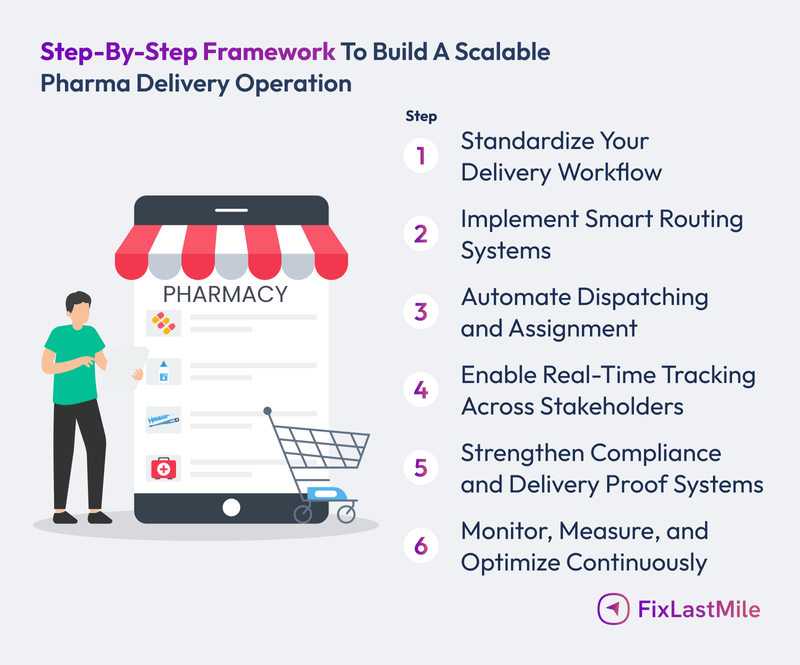
Step 1: Standardize Your Delivery Workflow
Start by defining a clear and consistent delivery process. Without standardization, scaling only multiplies confusion.
Break your workflow into fixed stages:
-
Order received
-
Order verified
-
Assigned to driver
-
Out for delivery
-
Delivered with proof
Every delivery should follow the same sequence. This ensures that your team does not rely on memory or manual coordination.
Also define rules such as:
-
How orders are prioritized
-
What qualifies as urgent delivery
-
How failed deliveries are handled
Why this matters:
A standardized workflow creates predictability. It allows your system to handle more deliveries without increasing operational errors.
Step 2: Implement Smart Routing Systems
Routing directly impacts delivery time and cost. Poor routing becomes a major bottleneck as volume grows.
A smart routing system should:
-
Plan multi-stop deliveries efficiently
-
Prioritize time-sensitive deliveries
-
Reduce unnecessary travel distance
Instead of assigning deliveries one by one, group them based on location and delivery windows.
What changes after implementation:
Drivers follow optimized routes instead of relying on manual instructions. This reduces delays and improves on-time delivery rates.
Expert Tip:
Do not rely on map navigation alone. Route optimization should happen before dispatch, not during delivery.
Step 3: Automate Dispatching and Assignment
Manual dispatching works at low volume but fails quickly as orders increase. You need a system that assigns deliveries automatically.
Set clear rules for assignment:
-
Assign based on driver proximity
-
Prioritize urgent or time-bound deliveries
-
Balance workload across drivers
Automation ensures that every order is assigned immediately without waiting for dispatcher intervention.
Why this matters:
It removes dependency on human coordination and reduces assignment delays, which are one of the biggest causes of missed SLAs.
Step 4: Enable Real-Time Tracking Across Stakeholders
As delivery volume increases, visibility becomes critical. Without tracking, you lose control over operations.
Your system should provide:
-
Live delivery status for admin teams
-
Real-time tracking links for customers
This ensures that everyone involved has access to accurate information.
Operational impact:
-
Fewer support calls
-
Faster issue resolution
-
Better customer trust
Step 5: Strengthen Compliance and Delivery Proof Systems
Pharma delivery requires strict documentation. As volume increases, manual documentation becomes unreliable.
Implement digital proof of delivery methods:
-
OTP verification
-
Digital signatures
-
Image capture
Also maintain structured audit logs for every delivery.
Why this matters:
-
Ensures compliance with healthcare regulations
-
Reduces disputes and failed delivery claims
-
Prepares your operation for audits
Without a strong proof system, scaling increases compliance risk.
Step 6: Monitor, Measure, and Optimize Continuously
Scaling is not a one-time setup. It requires continuous monitoring and improvement.
Track key performance indicators such as:
-
On-time delivery rate
-
Delivery turnaround time
-
Failed deliveries
-
SLA violations
Use this data to identify:
-
Delays in specific routes
-
Underperforming drivers
-
Process inefficiencies
What this enables:
-
Data-driven decision making
-
Continuous improvement in operations
-
Better resource utilization
Expert Tip:
Review performance data weekly. Monthly reviews are too late to correct operational issues at scale.
Key Metrics to Track for Scalable Pharma Delivery
Tracking performance is essential for maintaining control at scale. The key metrics to track for scalable pharma delivery are:
| KPI | What It Measures | Why It Matters |
|---|---|---|
| On-Time Delivery Rate | Delivery punctuality | SLA compliance |
| Delivery Turnaround Time | Speed of delivery | Customer satisfaction |
| Failed Deliveries | Delivery success rate | Cost control |
| Driver Utilization | Efficiency | Resource optimization |
| SLA Violations | Missed commitments | Risk indicator |
Real-World Scenario: Scaling from 50 to 500 Deliveries per Day
Understanding the transition in the real world helps you apply these principles effectively.
Before Scaling
-
Dispatching handled manually
-
Frequent delivery delays
-
Limited visibility into operations
The system struggles as volume increases.
After Implementing a Scalable System
-
Automated routing improves efficiency
-
Real-time tracking provides control
-
SLA performance improves significantly
The operation becomes predictable and manageable.
Common Mistakes to Avoid When Scaling Pharma Delivery
Avoiding these mistakes can save time and resources.
Over-Reliance on Manual Processes: Manual systems cannot scale efficiently. They create delays and errors.
Ignoring Compliance Requirements: Compliance gaps can lead to serious operational and legal consequences.
Not Investing in Real-Time Visibility: Without visibility, managing large-scale operations becomes difficult.
Scaling Volume Without Systems: Increasing delivery volume without proper systems leads to operational breakdown.
Conclusion
Scaling pharma delivery is not about increasing volume. It is about building an operation that stays stable, predictable, and compliant as demand grows.
When your workflows are standardized, routing is optimized, and dispatch is automated,
-
You remove the daily chaos that slows your team down.
-
You stop reacting to problems and start controlling outcomes.
If you continue with manual coordination, every additional order adds pressure.
-
Delays increase
-
Visibility drops, and
-
Compliance risks grow
A structured pharmacy delivery system ensures that every delivery follows a defined process, no matter how much you scale.
If you want to scale without these problems, you need a last mile delivery software for medicines designed for it.
This is exactly where FixLastMile pharmacy delivery software fits in.
It gives you structured routing, automatic dispatch, real-time visibility, and audit-ready proof in one place. So you do not just manage deliveries. You run a controlled, scalable operation.
Scale pharma deliveries with FixLastMile. Cut delays, errors, and risks.
FAQs
Pharma delivery software helps you manage routing, dispatch, tracking, and proof of delivery in one system. It reduces delays, improves SLA performance, and ensures compliance by automating workflows and giving full visibility into operations.
You can reduce delays by using route optimization and automated dispatch. These systems assign deliveries based on proximity and priority, helping drivers follow efficient routes and ensuring time-sensitive orders are delivered within SLA.
Proof of delivery ensures that every order is documented with signature, OTP, or image confirmation. It helps you stay compliant, reduces disputes, and creates a reliable audit trail required for regulated pharma deliveries.
You should switch when you start facing delays, dispatcher overload, or increasing delivery volume. If your team relies on manual coordination or spreadsheets, it indicates your operation needs a structured and scalable system.