Prescription delivery is not like regular parcel delivery.
When a food order reaches the wrong address, the customer may ask for a refund. When the wrong prescription reaches the wrong patient, the consequences are far more serious. A missed handoff, incorrect medicine, dosage mismatch, or weak proof of delivery can create legal exposure, compliance issues, and direct patient safety risks.
This is one of the biggest reasons pharmacies are rethinking how deliveries are verified.
For high-volume pharmacies, manual verification creates too many operational gaps. Staff rely on handwritten notes, dispatchers depend on memory, and delivery teams often complete proof of delivery without strong verification. Small mistakes quickly become expensive problems.
This is where barcode scanning changes the entire workflow.
With modern pharmacy dispatch software, dispatch teams and drivers can scan medicines before dispatch, validate driver pickup, confirm patient handoff, and create secure proof of delivery records in real time. The result is not just faster delivery operations, but safer, more compliant, and more reliable pharmacy delivery management.
Let us look at how barcode scanning improves delivery accuracy and why it has become a core operational requirement.
Why Pharmacy Delivery Accuracy Is a High-Risk Operational Priority
Accuracy in pharmacy delivery is not just an operational target. It is a business protection system.
A Small Delivery Error Can Create a Major Compliance Problem
A pharmacy delivery is complete only when the right medicine reaches the right patient, at the right time, with the right verification.
If even one part fails, the business may face:
-
wrong medicine delivery
-
incorrect patient handoff
-
dosage mismatch risk
-
legal complaints
-
patient trust damage
-
contract disputes with hospitals or healthcare providers
Unlike standard delivery businesses, pharmacies operate in a highly sensitive environment. Every delivery has medical implications.
That is why businesses using strong pharmacy dispatch software focus heavily on verification before delivery, not after complaints happen.
Why Manual Verification Fails at Scale
Manual verification may work when delivery volumes are low.
But once daily orders increase, the process becomes fragile.
Dispatch teams start depending on paper notes, phone calls, and repeated confirmations. Drivers collect multiple packages under time pressure. Failed delivery attempts are recorded manually. Audit trails become incomplete.
A large NHS London study covering 613,868 medication administrations found that medication scanning rates ranged from 5.6% to 67%, while patient scanning ranged from 4.6% to 89%. This proves that compliance depends heavily on workflow quality, not just technology.
Manual systems break because people are overloaded.
Barcode scanning reduces this risk by creating mandatory checkpoints.
The Hidden Cost of Delivery Inaccuracy
Many pharmacy operators only calculate visible costs like refunds.
But the hidden costs are often bigger.
These include repeat dispatch costs, failed SLA commitments, delayed patient treatment, customer complaints, pharmacy reputation damage, and lost healthcare contracts.
A single failed hospital delivery can impact long-term trust.
Accuracy is not only a service issue. It is a revenue issue.
Expert Tip:
Track “delivery exception cost per order” inside your reporting dashboard. Most operators track failed deliveries, but not the actual financial loss attached to them. This creates blind spots in operational decision-making.
What Is Barcode Scanning in Pharmacy Delivery Operations?
Barcode scanning creates digital verification inside the delivery workflow.
Simple Definition for Delivery Teams
Barcode scanning in pharmacy delivery is the process of digitally verifying medicine packages, prescriptions, delivery orders, and recipient confirmation using scannable barcodes before dispatch and at final delivery.
Instead of relying only on manual checks, the system confirms whether the package, prescription, and recipient match correctly before the delivery moves forward.
This reduces preventable mistakes and strengthens compliance.
Where Barcode Scanning Fits in the Delivery Workflow
Barcode scanning supports multiple stages of pharmacy logistics.
It starts during warehouse verification when staff scan the medicine package before dispatch preparation. It continues during driver pickup validation to ensure the correct parcel is assigned.
At final delivery, the driver scans again to confirm the right handoff.
It also supports failed delivery tracking, returns management, and exception handling.
This creates a full verification chain from dispatch to doorstep.
Types of Barcode Verification Used in Pharmacy Logistics
Different delivery stages require different validation layers.
Common examples include:
-
medicine package barcode
-
prescription ID barcode
-
delivery manifest barcode
-
patient verification code
-
proof of delivery scan confirmation
The goal is not simply scanning for records. The goal is operational control.
When barcode verification is connected directly with pharmacy dispatch software, delivery teams gain real visibility instead of disconnected scan logs.
How Barcode Scanning Improves Delivery Accuracy
Barcode scanning improves delivery accuracy because it removes guesswork from the delivery process.
Preventing Wrong Medicine Dispatch Before the Driver Leaves
Many delivery mistakes happen before the route even starts.
A wrong parcel gets placed in the pickup area. A dispatcher assigns the wrong order. A driver leaves with the wrong medicine package.
Barcode scanning stops these problems early.
Before dispatch, the medicine package is scanned against the delivery order. If there is a mismatch, the system flags it immediately.
In the NHS study, 37% of scan mismatch alerts changed user action, showing that barcode systems actively prevent errors rather than simply recording them.
This is where strong pharmacy dispatch software creates real operational value.
Reducing Wrong Recipient Deliveries During Final Handover
Final doorstep delivery is another high-risk moment.
Patients may have similar names. Hospital wards may have multiple recipients. Drivers often work under strict delivery timelines.
Barcode scanning paired with OTP verification improves recipient validation.
Instead of relying only on verbal confirmation, the system validates identity before marking delivery complete.
This improves both delivery accuracy and legal defensibility.
Eliminating Manual Entry Errors in Delivery Records
Manual entry creates silent operational damage.
Drivers forget timestamps. Dispatchers update the wrong status. Failed delivery reasons are incomplete. Paper signatures go missing.
Barcode scanning reduces paperwork and creates automatic system updates.
The result is stronger reporting, cleaner proof of delivery, and better operational control.
Manual Verification vs Barcode-Based Pharmacy Delivery Verification
| Process Area | Manual Verification | Barcode Scanning Verification |
|---|---|---|
| Package Matching | Human check only | System-verified scan |
| Delivery Proof | Paper signature | Digital timestamped proof |
| Compliance Audit | Hard to track | Full audit trail |
| Delivery Accuracy | High error risk | Controlled validation |
| Failed Deliveries | More frequent | Significantly reduced |
How Barcode Scanning Strengthens Compliance in Pharmacy Dispatch Software
Compliance is built on traceability.
If you cannot prove what happened during delivery, compliance becomes difficult to defend.
Building Stronger Audit Trails for Regulated Deliveries
Pharmacy operators must show delivery history clearly.
That means knowing:
-
when the medicine was prepared
-
who dispatched it
-
which driver picked it up
-
when the delivery happened
-
how the handoff was confirmed
-
what happened if delivery failed
Paper logs cannot handle this reliably.
Barcode scanning creates digital timestamps, scan records, and delivery history inside pharmacy dispatch software, making audits faster and more reliable.
Supporting HIPAA and Sensitive Prescription Handling
For US pharmacy delivery operations, patient privacy matters as much as delivery speed.
Barcode scanning supports secure workflows by reducing unnecessary exposure of patient information during delivery.
Instead of handwritten paperwork, delivery teams work through controlled system verification.
This supports stronger compliance readiness when combined with secure access controls and protected delivery records.
Improving Proof of Delivery for High-Value Medicines
Some medicines require stronger proof than a paper signature.
Controlled prescriptions, specialty medicines, and expensive healthcare deliveries demand better documentation.
A strong workflow combines:
barcode scan + OTP confirmation + timestamp + GPS + digital signature
This reduces disputes and protects both the pharmacy and the patient.
Expert Tip:
Set different proof of delivery rules by medicine category. High-value prescriptions should require stronger delivery validation than standard refill deliveries. One workflow should not be used for every case.
The Role of Barcode Scanning Inside Modern Pharmacy Dispatch Software
Barcode scanning becomes far more valuable when it works inside a connected delivery system.
Connecting Barcode Scanning with Route Optimization
Route optimization improves delivery efficiency, but route quality depends on verified dispatch.
If the wrong medicine enters the route, even the best routing system fails.
Barcode validation before dispatch ensures only confirmed packages enter the delivery schedule.
This reduces route failures, repeat visits, and failed handoffs.
It protects both compliance and route efficiency.
Driver App Integration for Real-Time Field Execution
Mobile workflows matter.
A recent study found barcode medication administration compliance was 11.7 percentage points higher when mobile devices were used compared to standard devices.
This is highly relevant for pharmacy delivery teams.
Drivers need scanning inside the app they already use, not separate disconnected devices.
Good pharmacy dispatch software should support:
-
scan before pickup
-
scan at final handover
-
failed delivery attempt tracking
-
return package verification
-
live delivery status updates
This turns the driver app into a compliance tool, not just a navigation screen.
Analytics and Reporting for Delivery Performance Monitoring
Scan data creates visibility.
Managers can track failed deliveries, compliance rates, repeated mismatch alerts, driver accountability, and operational bottlenecks.
This helps prevent repeated errors instead of simply reacting to complaints.
Reporting is where delivery accuracy becomes measurable.
Best Practices for Implementing Barcode Scanning in Pharmacy Delivery
Technology works only when process discipline supports it.
Standardize Every Package Before Dispatch
Barcode success starts with packaging.
Labels must be readable, consistently placed, and linked correctly with prescription records.
The NHS study found that the most common reasons for failed scanning were barcode not readable and scanner unavailability.
This shows that implementation matters more than intention.
Scanning discipline must be part of the operational SOP.
Train Drivers for Scan-Based Delivery Completion
Drivers should not see scanning as extra work.
They should understand it as patient protection.
Training must cover when to scan, what to do when scans fail, how to handle mismatches, and how to record failed attempts correctly.
Without adoption, even the best system becomes weak.
Use Software That Connects Dispatch, Driver App, and Proof of Delivery
Disconnected tools create disconnected accountability.
A scanner without dispatch visibility creates duplicate work. A driver app without proof of delivery creates reporting gaps.
The best setup connects dispatch, scanning, proof of delivery, route optimization, and reporting inside one system.
This is why choosing the right pharmacy dispatch software matters.
Expert Tip:
Never allow manual delivery completion without exception approval. If barcode verification is skipped, the system should force a reason code and escalation path. This protects audit readiness.
What Pharmacy Operators Should Look for Before Choosing a Barcode-Enabled Delivery System?
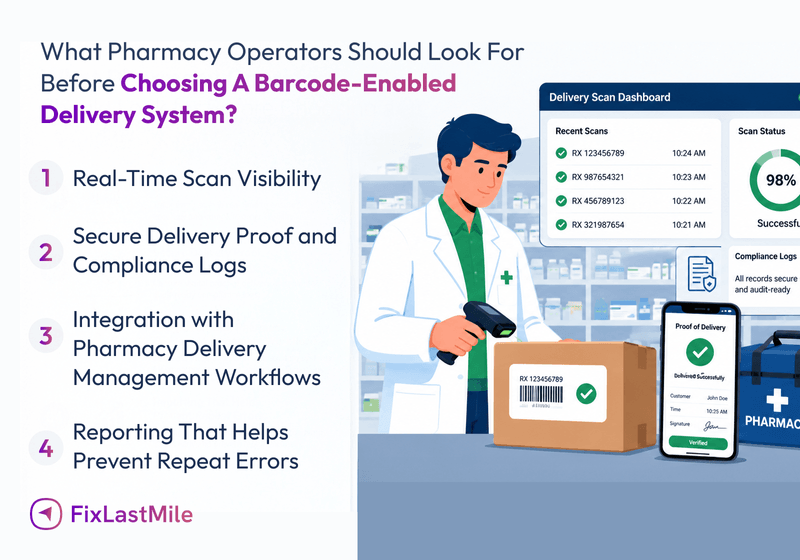
Not every delivery platform is designed for pharmacy operations.
The right system should support compliance, accuracy, and operational control together.
Real-Time Scan Visibility
Managers should see scan status live.
They should know which packages are pending verification, which deliveries are completed, and where failures are happening.
Without visibility, barcode scanning becomes reactive instead of preventive.
Secure Delivery Proof and Compliance Logs
Proof of delivery should be secure, searchable, and audit-ready.
This includes timestamped records, driver identity, recipient confirmation, digital signatures, and delivery exceptions.
Strong compliance depends on strong records.
Integration with Pharmacy Delivery Management Workflows
Barcode scanning must work inside real pharmacy operations.
It should connect with order creation, dispatch assignment, driver workflows, failed delivery handling, and returns management.
A barcode tool alone is not enough.
The real value comes from connected pharmacy dispatch software.
Reporting That Helps Prevent Repeat Errors
The best reporting helps operators improve.
It should show delivery exception patterns, failed delivery causes, driver scan compliance, and repeat operational gaps.
Better reporting means fewer repeated mistakes.
Conclusion
Barcode scanning is no longer a nice-to-have feature in pharmacy delivery operations.
It has become a core requirement for businesses that want better delivery accuracy, stronger compliance readiness, and long-term patient trust.
As prescription delivery volumes grow, manual verification creates too much operational exposure. Small mistakes quickly become expensive problems, especially when proof of delivery is weak or audit trails are incomplete.
Barcode-enabled pharmacy dispatch software creates a safer system where every package, every handoff, and every delivery record becomes verifiable and trackable. It reduces failed deliveries, improves compliance visibility, and strengthens operational control across the entire workflow.
For pharmacies serious about delivery excellence, barcode scanning is not just a process improvement.
It is a business protection system.
Improve delivery accuracy. Strengthen compliance. Protect every prescription.
FAQs
Pharmacy dispatch software helps pharmacies manage prescription deliveries, driver assignments, route planning, proof of delivery, and compliance tracking from one centralized system.
Barcode scanning verifies medicine packages, prescriptions, and recipient details before dispatch and delivery, reducing wrong medicine handoffs, failed deliveries, and manual verification errors.
Barcode scanning creates digital proof of delivery, timestamps, scan records, and audit trails that help pharmacies maintain compliance, improve traceability, and handle disputes more effectively.
Yes. By validating packages before dispatch and confirming recipient identity during handoff, pharmacy dispatch software helps reduce failed deliveries, repeat dispatch costs, and delivery disputes.
Barcode scanning supports HIPAA-ready workflows by reducing manual paperwork and improving controlled delivery verification, but full compliance also depends on secure access controls and data protection policies.
A pharmacy driver app should include barcode scanning, live route updates, proof of delivery, failed delivery tracking, return management, and real-time communication with dispatch teams.
Proof of delivery usually includes barcode verification, recipient confirmation, digital signature, timestamp, GPS location, and delivery status updates for secure and traceable handoffs.
Yes. Barcode scanning is especially useful for high-value medicines because it strengthens delivery verification, reduces disputes, and creates stronger legal documentation for sensitive prescriptions.
The most common reasons are unreadable barcodes, poor label placement, scanner unavailability, disconnected workflows, and lack of driver training during delivery operations.
Pharmacies should look for real-time scan visibility, route optimization, secure proof of delivery, compliance reporting, driver app integration, and complete workflow connectivity in one system.