Most customer complaints do not start with a bad support team.
They start much earlier, when your customer has no idea where their order is, when it will arrive, or what happens if the delivery gets delayed.
This is the real visibility gap in last mile delivery.
When customers cannot track deliveries clearly, trust drops fast. They start calling support repeatedly. Dispatch teams get interrupted. Failed deliveries increase. Negative reviews follow. What looks like a customer service issue is often an operations problem.
This becomes even more serious in businesses like pharmacy delivery software, grocery delivery, courier services, and same day fulfillment, where timing directly affects customer satisfaction and retention.
A customer waiting for medicine, groceries, or an urgent courier delivery does not just want speed. They want certainty.
If your delivery process creates uncertainty, your customer experience suffers even when deliveries are technically completed.
In this blog, you will learn how visibility gaps silently damage your delivery operations, why they hurt retention, and how the right last mile delivery software helps you fix the problem before it becomes expensive.
What Is a Visibility Gap in Last-Mile Delivery?
Before fixing the problem, you need to understand where the gap actually starts.
Visibility Gap Means Missing Delivery Transparency
A visibility gap happens when customers and internal teams cannot clearly see delivery progress in real time.
This usually includes:
-
No real-time tracking
-
No accurate ETA updates
-
No delay alerts
-
No delivery status updates
-
No delivery completion confirmation
-
No proof of delivery visibility
Your customer places an order, receives a confirmation, and then hears nothing. That silence creates friction.
Even if your driver is on the way, the customer feels disconnected from the process. They start wondering:
-
Where is my order?
-
Is it delayed?
-
Will it arrive today?
-
Do I need to stay available?
This uncertainty creates frustration faster than the actual delay.
That is why delivery tracking software is not just a logistics tool. It directly shapes customer experience.
Why It Happens in Manual Delivery Operations
Most visibility gaps come from manual delivery workflows.
Common causes include:
-
Dispatcher dependency for updates
-
Poor driver communication
-
Outdated dispatch systems
-
No centralized delivery dashboard
-
No customer-facing tracking link
-
Disconnected driver and customer communication
When your team depends on phone calls, spreadsheets, and manual follow-ups, visibility breaks naturally.
Support teams start chasing drivers. Dispatchers become update providers instead of operations managers. And customers become frustrated because nobody gives proactive answers.
This is not a support issue. It is an operational design problem.
Expert Tip:
If your support team spends most of its time answering “Where is my order?” questions, your problem is not support staffing. Your problem is delivery visibility.
How Visibility Gaps Directly Damage Customer Experience
Now let us look at what this gap actually costs your business.
Customers Lose Trust When They Cannot Track Deliveries
Customers tolerate delays better than uncertainty.
This is especially true for:
-
Medicine delivery
-
Same day grocery delivery
-
Scheduled courier deliveries
-
Temperature-sensitive deliveries
-
Urgent business shipments
If a delivery is late but the customer knows why, trust can still be protected. If the delivery is silent, trust drops quickly.
For example, in online pharmacy delivery software, a customer waiting for prescription medicine is not simply waiting for a package. They may be waiting for something medically important.
No visibility creates anxiety. And anxious customers rarely become loyal customers.
This is why real-time delivery notifications matter more than most businesses realize.
Repeated “Where Is My Order?” Calls Increase Support Pressure
When customers cannot see delivery progress, they call. Then they call again. These WISMO calls (“Where Is My Order?”) create serious operational pressure.
Your support team stops solving actual problems and becomes a delivery tracking department.
This causes:
-
Slower response times
-
Dispatcher interruptions
-
Delayed issue resolution
-
Internal confusion
-
Customer dissatisfaction
Instead of improving service quality, your team spends time repeating information manually.
That is expensive and unnecessary.
With proper last mile delivery management software, customers should not need to ask basic delivery questions.
The system should answer them automatically.
Failed Deliveries Increase Due to Poor Coordination
Many failed deliveries are preventable.
They happen because customers were not prepared.
Examples include:
-
Customer unavailable at delivery time
-
Unclear address instructions
-
Missed delivery windows
-
Gated access problems
-
No arrival preparation
When customers receive live updates, they can prepare. When they receive no updates, delivery success depends on luck. This increases reattempt costs, driver inefficiency, and operational waste.
In businesses using delivery management software, reducing failed first attempts often creates immediate cost savings. Because every failed delivery is not just a delay. It is a second operational expense.
Negative Reviews and Lower Retention Follow
Customers remember uncertainty more than delivery speed. A slightly delayed order with good communication often gets a better review than a fast order with poor visibility.
That is because confidence matters. Customers want to feel informed and in control. Without that, they remember stress.
That affects:
-
Google reviews
-
Repeat orders
-
Referral trust
-
Customer retention
-
Brand perception
This is especially damaging in competitive industries where switching providers is easy. Poor transparency reduces long-term revenue more than most operators expect.
Visibility Gap vs Customer Experience Impact
This table helps you see how small operational gaps create larger business consequences.
| Visibility Problem | Customer Impact | Business Impact |
|---|---|---|
| No live tracking | Anxiety and repeated calls | Higher support workload |
| No ETA updates | Missed expectations | Lower satisfaction |
| No delay alerts | Frustration and complaints | SLA violations |
| No proof confirmation | Trust issues | Delivery disputes |
| No status visibility | Poor delivery perception | Lower retention |
This is why customer experience in last mile delivery must be treated as an operational priority, not only a support metric.
Why This Problem Is Worse in Pharmacy and Healthcare Deliveries
Some industries can tolerate small delivery uncertainty. Healthcare cannot.
Prescription Deliveries Depend on Timing and Trust
Customers waiting for medicines cannot accept vague delivery communication.
They need certainty. A delayed grocery order is frustrating.
A delayed prescription delivery can affect treatment, medication schedules, and patient confidence.
In pharmacy delivery software, visibility becomes part of patient care.
Customers want to know:
-
When the medicine was dispatched
-
Who is delivering it
-
When it will arrive
-
Whether delays exist
-
Whether delivery is completed safely
Without this transparency, trust falls immediately.
This is why medical delivery software must prioritize visibility, not just dispatch speed.
Compliance and Audit Requirements Need Delivery Proof
Healthcare delivery also requires stronger accountability.
You need:
-
Proof of delivery
-
Audit trail
-
Delivery verification
-
Operational accountability
-
Compliance readiness
This supports both customer trust and internal protection.
If disputes happen, you need clear records.
If audits happen, you need verifiable delivery proof.
This is why proof of delivery software is not optional in pharmacy operations.
It protects revenue, compliance, and reputation.
Expert Tip:
If your delivery process cannot show who delivered, when it happened, and how completion was verified, your compliance risk is already higher than you think.
How Real-Time Delivery Visibility Solves the Visibility Gap Problem
The solution is not more support agents. It is better delivery transparency. Here’s how the visibility gap problem is solved:
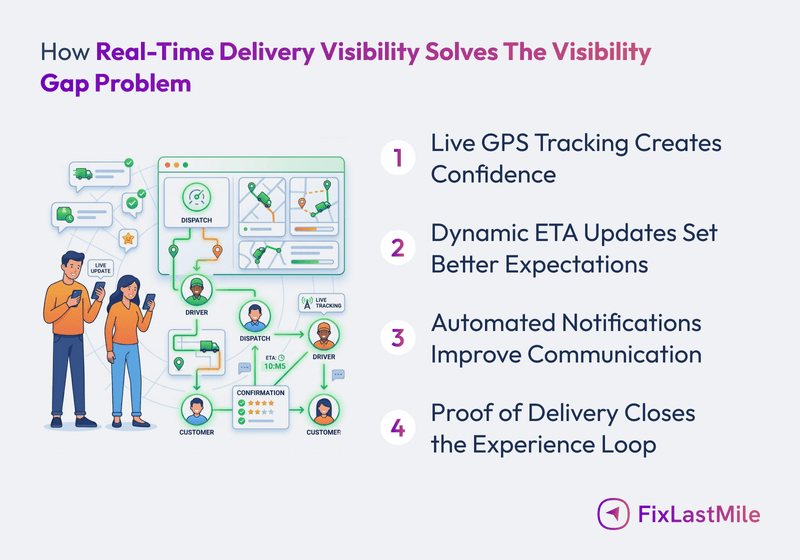
Live GPS Tracking Creates Confidence
When customers and dispatchers can see where deliveries are, uncertainty drops immediately.
Live GPS tracking helps:
-
Customers feel informed
-
Dispatchers manage exceptions faster
-
Support teams reduce unnecessary calls
-
Drivers avoid repeated location questions
Visibility creates confidence because information becomes accessible without manual intervention.
This is one of the strongest reasons businesses adopt delivery tracking software.
Dynamic ETA Updates Set Better Expectations
Static ETAs create disappointment. Dynamic ETAs create realistic expectations.
If traffic changes or delays happen, customers should know early.
People tolerate delays better when they are informed before frustration starts. Expectation management improves satisfaction more than perfect speed. That is why strong last mile delivery software must provide dynamic ETA updates.
Automated Notifications Improve Communication
Customers should never depend on manual calls for basic delivery updates.
Automated alerts should cover:
-
Driver assigned
-
Order dispatched
-
Driver nearby
-
Delayed delivery warning
-
Delivery completed
This creates proactive communication. And proactive communication builds trust. It also protects your team from repetitive operational work.
Proof of Delivery Closes the Experience Loop
The final stage matters most. Customers need confirmation that delivery is completed properly.
Examples include:
-
OTP verification
-
Signature capture
-
Photo proof
-
Barcode confirmation
This removes disputes and improves accountability. Without proof, delivery is incomplete from the customer’s perspective. With proof, the experience closes cleanly.
Final Operational Check
Ask yourself:
-
Can customers track deliveries without calling support?
-
Do dispatchers receive live delay alerts?
-
Can teams see failed delivery reasons instantly?
-
Is delivery proof captured automatically?
-
Are ETA updates dynamic and accurate?
If the answer is no, visibility is already costing your business revenue.
Expert Tip:
Do not measure delivery performance only by on-time delivery percentage. Measure how informed your customer feels during the journey. That is where retention is built.
Conclusion
Customer experience problems in last mile delivery rarely begin at customer support. They begin when your customers are left guessing. When there is no live tracking, no ETA updates, and no delivery confirmation, trust drops quickly.
This leads to repeated support calls, failed deliveries, negative reviews, and lower customer retention.
In industries like pharmacy, grocery, and courier delivery, visibility is not just a convenience. It directly affects customer confidence, operational efficiency, and long-term business growth. Customers want transparency as much as they want speed.
That is why investing in the right last mile delivery software becomes a business decision, not just a technology upgrade. FixLastMile, you can improve delivery visibility, reduce operational friction, and create a delivery experience your customers trust and return for.
Stop losing customers to delivery uncertainty.
FAQs
Customers become frustrated when they do not know where their order is or when it will arrive. This uncertainty creates repeated support calls, trust issues, and negative delivery experiences.
Real-time delivery tracking gives customers live order updates, accurate ETAs, and proactive delay alerts. This reduces anxiety, improves trust, and helps customers feel more in control of the delivery process.
In pharmacy deliveries, delays can affect patient care. Customers waiting for medicines need clear delivery updates, proof of delivery, and reliable communication to maintain trust and compliance.
Proof of delivery uses OTP verification, photo proof, barcode scans, or digital signatures to confirm successful delivery. This creates accountability and helps resolve customer disputes quickly.
Failed deliveries often happen when customers are unavailable, unaware of arrival times, or miss delivery windows. Real-time notifications help customers prepare and reduce avoidable delivery failures.
FixLastMile helps businesses improve delivery visibility through live tracking, proof of delivery, route optimization, dispatcher control, and real-time customer notifications for better customer experience.