A pharmacy delivery mistake is never a small mistake.
When the wrong medicine reaches the wrong patient, the issue goes beyond logistics. It directly impacts patient safety, treatment timelines, and trust. A delayed prescription can disrupt recovery. A failed delivery can trigger repeat dispatches, support escalations, and refund cycles. In temperature-sensitive cases, even a short delay can make the medicine unusable.
Many pharmacies still rely on manual verification, paper-based workflows, and driver confirmation through calls. These methods may work at a smaller scale, but as delivery volume increases, the risk of error grows rapidly.
This is where pharmacy delivery software plays a critical role. By combining barcode scanning and real-time alerts, it creates a controlled system where each package is verified, every delivery is traceable, and operational issues are visible before they escalate.
Accuracy in pharmacy logistics is not just about faster delivery. It is about building reliability, compliance, and long-term patient trust.
Why Delivery Errors Are a Serious Problem in Pharmacy Logistics
Common Delivery Errors That Pharmacies Face
Pharmacy delivery operations deal with sensitive products, which makes even minor mistakes significant. Errors often occur when the wrong medicine is assigned to a delivery route or when packages are handed over to the wrong recipient. In some cases, deliveries are marked complete without proper confirmation, or temperature-sensitive medicines are exposed to delays that affect their effectiveness.
These issues usually arise from manual processes where dispatch teams rely on visual checks and handwritten notes. As delivery volumes increase, the chances of mismatch and oversight grow, making these errors more frequent and harder to control.
The Real Cost of These Errors
The impact of delivery errors is not limited to operational inefficiency. It directly affects customer trust and business credibility. Patients who receive incorrect or delayed medication lose confidence in the pharmacy. At the same time, businesses face financial losses due to returns, re-deliveries, and refunds.
Compliance risks also increase, especially when there is no clear proof of delivery or traceability. Support teams end up handling more complaints, which adds to operational pressure. Over time, these issues begin to affect brand reputation and long-term customer retention.
For pharmacies adopting pharmacy delivery software, reducing these risks becomes essential for maintaining both service quality and business growth.
Why Manual Verification Fails in High-Volume Pharmacy Deliveries
Paper-Based Checks and Human Errors
Manual workflows depend heavily on human accuracy, which is difficult to maintain consistently at scale. Dispatchers often match prescriptions manually, and drivers rely on printed lists or verbal confirmation during delivery. In such systems, even a small oversight can lead to incorrect deliveries or missing proof records.
As the number of daily deliveries increases, these small gaps turn into repeated errors. The lack of structured validation at each step makes it difficult to maintain consistency, especially during peak delivery hours.
Lack of Real-Time Visibility Creates Operational Blind Spots
Another major limitation of manual systems is the lack of real-time visibility. Without live tracking, delivery teams cannot identify delays or failed attempts immediately. Customers are left without updates, which leads to uncertainty and repeated follow-ups.
Operations teams also struggle to respond quickly because they depend on driver communication instead of system alerts. This delay in response increases the chances of failed deliveries and poor customer experience.
Manual Verification vs Automated Delivery Validation
| Manual Process | Barcode + Real-Time Alerts |
|---|---|
| Relies on human checks | Uses scan-based verification |
| Issues identified late | Problems detected instantly |
| Higher delivery failure rate | Improved delivery accuracy |
| Limited proof records | Complete audit trail |
| No real-time updates | Full delivery visibility |
This shift from manual to automated validation is what enables pharmacies to operate with control and confidence.
How Barcode Scanning Improves Delivery Accuracy in Pharmacy Delivery Software
Package-Level Verification Before Dispatch
Barcode scanning introduces a structured verification layer at the dispatch stage. Before a package leaves the pharmacy, it is digitally matched with the corresponding delivery order. This ensures that the correct medicine is assigned to the right route and reduces the chances of mismatch early in the process.
By removing reliance on manual checks, pharmacies can significantly improve dispatch accuracy. This is especially useful for high-volume operations where speed and accuracy must work together.
Driver-Level Verification During Delivery
The second layer of verification happens during delivery. Drivers scan the package again before handing it over to the customer. This confirms that the correct package is being delivered and ensures that the recipient details match the order.
This process also captures proof of delivery in real time, which helps in maintaining accountability and reducing disputes. It is particularly important for sensitive deliveries where confirmation and traceability are critical.
Compliance and Audit Trail Benefits
Barcode-based workflows create a detailed record of each delivery. Every scan generates a timestamp, and every delivery action is logged within the system. This creates a clear audit trail that can be used for compliance checks, dispute resolution, and internal reviews.
Instead of relying on manual documentation, pharmacies can access accurate delivery records instantly. This improves both operational transparency and regulatory readiness.
Expert Tip:
Implement dual-scan validation, one at dispatch and one at delivery. This reduces mismatch risk significantly and ensures that errors are caught before reaching the customer.
How Real-Time Alerts Improve Medicine Delivery Software Performance
Instant Alerts for Delivery Exceptions
Delivery failures rarely happen suddenly. They begin as small issues such as delays, incorrect routes, or unavailable recipients. Without alerts, these problems go unnoticed until the customer raises a complaint.
Real-time alerts allow operations teams to detect these issues immediately. This makes it possible to take corrective action before the situation escalates into a failed delivery.
Real-Time Notifications for Customers and Operations Teams
Customers expect timely updates about their deliveries. Real-time notifications keep them informed at every stage, from dispatch to delivery completion. This reduces uncertainty and builds confidence in the service.
At the same time, operations teams gain visibility into delivery progress. They can monitor delays, track driver performance, and manage exceptions more efficiently.
Faster Response Means Better Patient Experience
When issues are identified early, response time improves. This leads to fewer missed deliveries and lower support call volume. Customers feel more confident when they receive regular updates, and this directly impacts satisfaction and retention.
For pharmacy logistics, where timing is critical, faster response can make a meaningful difference in overall service quality.
Expert Tip:
Configure alert triggers based on delivery priority. Critical prescriptions should generate faster escalation alerts compared to routine deliveries to ensure timely intervention.
How Pharmacy Delivery Software Brings Barcode Scanning and Alerts Together
Centralized Delivery Management
A complete pharmacy delivery software platform connects all delivery processes into one system. It manages dispatching, tracking, verification, and reporting from a single interface. This eliminates the need for multiple disconnected tools.
With centralized control, managers can monitor operations in real time, drivers follow structured workflows, and customers receive consistent updates.
Why Standalone Tools Create More Problems
Using separate systems for dispatch, tracking, and proof of delivery creates gaps in data and visibility. Teams often struggle to connect information across platforms, which slows down response time and increases manual effort.
This lack of integration leads to inconsistent records and makes compliance management more difficult.
Why Integrated Pharmacy Delivery Software Works Better
An integrated system ensures that all delivery data flows through one platform. This improves visibility, reduces manual effort, and enhances accuracy. Automated workflows reduce dependency on human intervention and make operations more predictable.
This is why businesses moving toward online medicine delivery software prefer integrated solutions over standalone tools.
Expert Tip:
Avoid splitting dispatch, tracking, and proof systems across different tools. Integration improves audit accuracy and reduces operational delays during issue resolution.
What to Look for in Pharmacy Delivery Software for Error-Free Deliveries
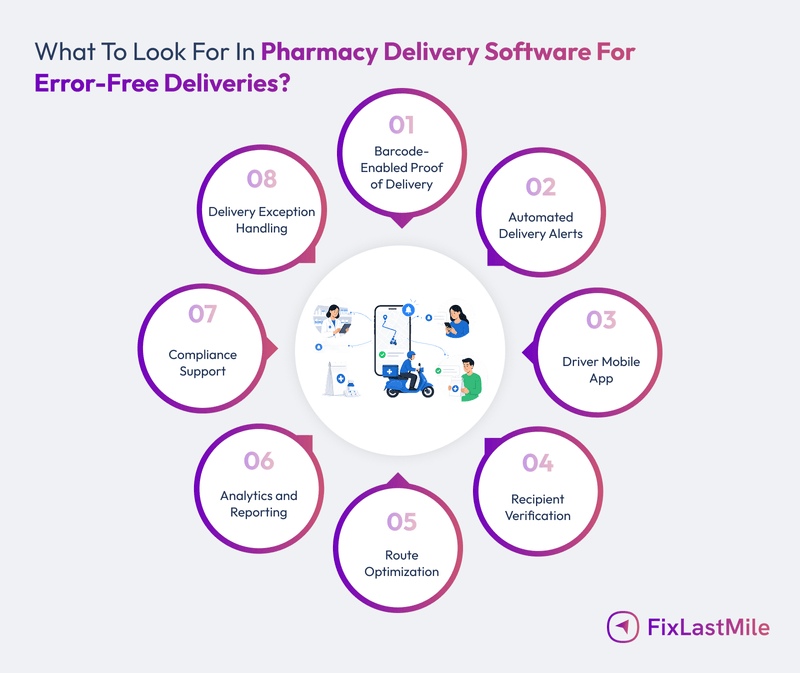
Choosing the right platform should go beyond delivery tracking.
Your checklist should include:
Barcode-Enabled Proof of Delivery
Every package should be verified using scan-based delivery validation.
Automated Delivery Alerts
The system should trigger alerts for failed attempts, delays, and delivery exceptions automatically.
Driver Mobile App
Drivers need clear workflows for navigation, scanning, recipient confirmation, and proof capture.
Recipient Verification
OTP, digital signatures, and recipient confirmation should be available based on delivery type.
Route Optimization
Smart route planning reduces delays and protects medicine quality during transit.
Analytics and Reporting
You need visibility into failed deliveries, repeat attempts, SLA performance, and operational bottlenecks.
Compliance Support
Audit-ready records and prescription traceability are essential for healthcare delivery.
Delivery Exception Handling
The platform should make exception management fast, structured, and visible.
The right pharmacy delivery software protects trust, improves operational control, and reduces avoidable delivery costs.
Final Thoughts: Accuracy Builds Trust in Pharmacy Deliveries
Pharmacy delivery is built on trust. Customers expect their medicines to arrive safely, correctly, and on time. When that expectation is not met, the impact goes beyond a single delivery. It affects patient safety, operational efficiency, and long-term business growth.
Barcode scanning and real-time alerts are no longer optional improvements. They are essential for modern pharmacy logistics. They reduce human error, improve visibility, and create a reliable delivery system.
If your current process still depends on manual verification and delayed updates, the risk is already present in your operations.
The right pharmacy delivery software helps you eliminate that risk and build a system that supports accuracy, compliance, and scale.
Reduce delivery errors before they impact patient trust.
FAQs
Barcode scanning ensures that the correct prescription is matched with the right delivery order and recipient, improving accuracy and traceability.
Real-time alerts provide instant updates on delivery status, delays, and exceptions, helping teams respond quickly and keep customers informed.
Proof of delivery confirms successful handover, reduces disputes, and supports compliance by maintaining a clear delivery record.
It should include barcode verification, delivery alerts, route optimization, proof of delivery, driver tracking, and compliance reporting for efficient operations.