A patient is waiting for an important prescription.
Your pharmacy has already dispatched the medicine, but the patient has no idea where it is.
There is no delivery update, no estimated arrival time, and no clear answer on when the medicine will arrive.
Within minutes, support calls begin. Your team checks with the dispatcher, the dispatcher calls the driver, and the patient keeps waiting with growing frustration.
This is where most pharmacy delivery problems begin.
In pharmacy logistics, delays are not just operational issues. They affect treatment continuity, patient trust, and your pharmacy’s reputation. Patients are not only expecting fast delivery. They want certainty, visibility, and confidence that their medicine will arrive on time.
This is why live delivery updates have become essential in modern pharmacy delivery management.
In this blog, you will learn how real-time delivery visibility improves patient experience, reduces support pressure, and helps your pharmacy build stronger trust from dispatch to doorstep.
Why Pharmacy Deliveries Need More Visibility Than Standard Deliveries
Before improving delivery operations, you need to understand why pharmacy logistics demands a different standard.
Food can be delayed. Groceries can wait. Medicines often cannot.
Patients waiting for prescriptions are not tracking convenience. They are tracking care.
An elderly patient waiting for blood pressure medication, a parent expecting urgent antibiotics for a child, or a chronic care patient depending on monthly medicine refills all need predictability.
That changes everything.
In pharmacy logistics, delays create:
-
Treatment interruptions
-
Missed doses
-
Patient anxiety
-
Trust issues
-
Compliance risks
Some medicines also require stricter handling.
Temperature-sensitive prescriptions, scheduled medications, and controlled substances require clear delivery confirmation and stronger accountability.
This makes real-time delivery notifications far more important than in standard retail delivery.
When patients know where their medicine is, they feel supported. When they do not, your pharmacy becomes the problem. That is why visibility is not optional in pharmacy delivery operations.
The Real Problem Is Not Late Delivery, It Is Delivery Uncertainty
Most delivery complaints begin long before the delivery is actually late. The real issue is uncertainty.
If a patient knows the driver is delayed by 20 minutes and receives that update clearly, frustration stays lower.
If the same patient hears nothing for 20 minutes, concern turns into repeated calls and complaints.
This is where many pharmacies struggle.
Without proper delivery tracking software, your team deals with:
-
Repeated “Where is my order?” calls
-
Manual driver follow-ups
-
Dispatcher overload
-
Missed first-attempt deliveries
-
Refund requests
-
Delivery disputes
-
Poor patient reviews
The problem is not only operational. It becomes emotional.
Patients feel ignored. And once trust drops, repeat prescriptions become harder to retain.
Here’s the quick comparison between delayed delivery with updates and without updates:
| Delayed Delivery with Updates | Delayed Delivery Without Updates |
|---|---|
| Patient feels informed | Patient feels ignored |
| Lower complaint risk | High complaint risk |
| Support calls reduce | Support calls increase |
| Trust remains stronger | Trust breaks faster |
Visibility matters more than speed alone.
A pharmacy with strong communication often performs better than a faster pharmacy with poor updates. That is why live delivery updates are a patient experience system, not just a notification feature.
Expert Tip:
Track your “Where is my order?” support tickets weekly. If this category keeps rising, your problem is usually not driver speed. It is delivery visibility.
What Live Delivery Updates Actually Include in Pharmacy Logistics
To improve delivery experience, you need to understand what complete delivery visibility actually looks like.
Many businesses think delivery updates mean one simple tracking message. That is incomplete.
In reality, live delivery updates create a full communication workflow from order confirmation to final proof of delivery.
A strong pharmacy delivery management system should include:
-
Order confirmation
-
Dispatch confirmation
-
Driver assigned notification
-
Estimated arrival time
-
Live driver tracking
-
Delay notifications
-
Delivery completed confirmation
-
Proof of delivery through OTP, photo, or signature
This creates confidence for both patients and internal teams.
Simple Delivery Flow
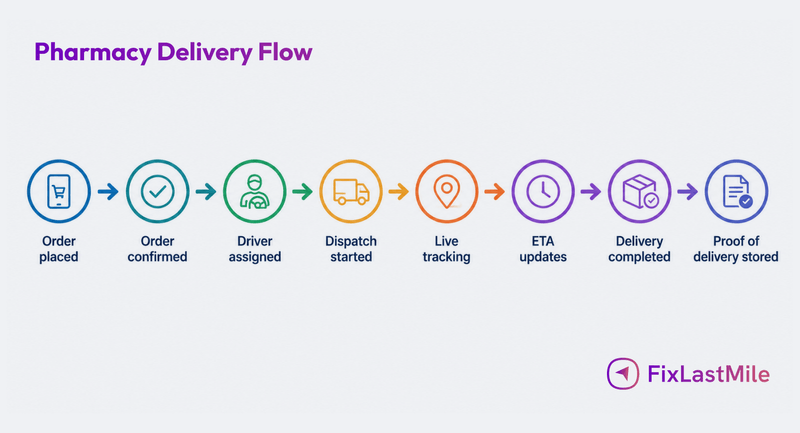
This process removes uncertainty.
It also creates an audit trail for compliance and dispute prevention.
For example, if a patient claims the order was never delivered, your team should not rely on memory. You should have proof.
That is where proof of delivery becomes critical.
This is especially important for prescription deliveries where trust and accountability must stay high.
Your delivery system should not only tell patients the order is coming. It should prove exactly what happened.
How Live Delivery Updates Improve Patient Experience
This is where visibility becomes real business value. The patient experience improves when communication becomes predictable.
Here’s how live delivery updates improve patient experience:
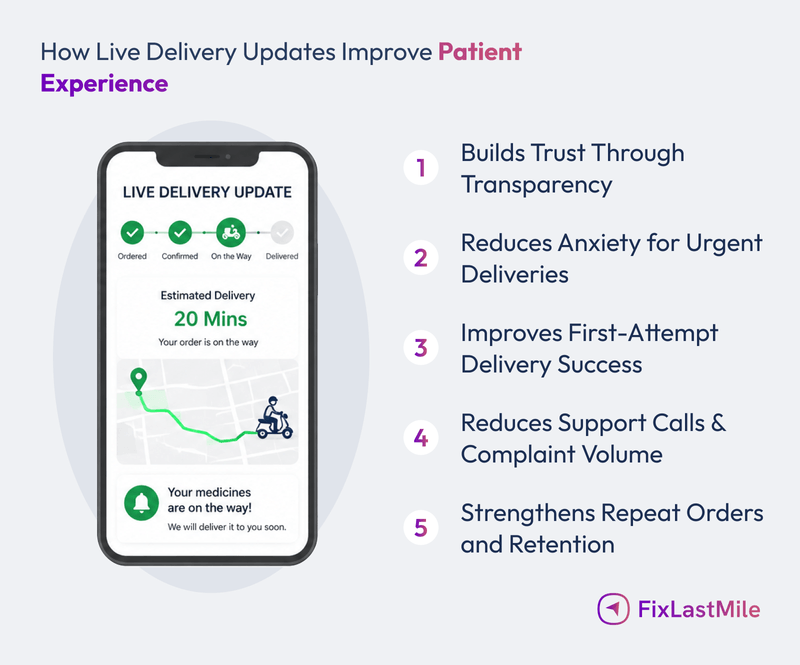
Builds Trust Through Transparency
Patients trust what they can see.
When they receive dispatch confirmation, driver details, and arrival updates, they feel informed and respected.
This reduces anxiety and creates confidence in your pharmacy.
Transparency turns delivery from a blind process into a reliable experience.
Reduces Anxiety for Urgent Deliveries
Patients waiting for urgent medicines are often already stressed.
Silence increases that stress.
Real-time updates help elderly patients, chronic medication users, and urgent prescription customers feel more secure.
This is especially important in healthcare, where uncertainty feels heavier than delay.
Improves First-Attempt Delivery Success
Failed deliveries waste time and money.
When patients know the exact arrival window, they stay available to receive the order.
This improves successful first-attempt deliveries and reduces repeat dispatch costs.
Reduces Support Calls and Complaint Volume
Support teams spend too much time answering avoidable questions.
Most patients call because they lack visibility.
When live updates are automated, support teams handle fewer interruptions and can focus on real issues instead of repeated status checks.
Strengthens Repeat Orders and Retention
Patients remember reliability.
When delivery feels smooth and predictable, they are more likely to reorder and trust your pharmacy for long-term care.
This improves customer retention and lifetime value.
Expert Tip:
Do not measure delivery success only by on-time delivery percentage. Also track repeat orders after delivery complaints. That shows the real business impact.
Operational Benefits for Pharmacy Teams Behind the Scenes
Better patient experience starts with better internal visibility. Your team benefits just as much as your customers.
For Operations Managers
You gain clearer delivery control. Instead of reacting to problems after complaints arrive, you can monitor delivery performance proactively.
This improves SLA tracking, escalation handling, and delivery accountability
For Dispatch Teams
Dispatchers stop relying on constant calls. They can manage routes faster, handle exceptions earlier, and improve driver coordination without manual chaos.
This reduces operational pressure significantly.
For Business Owners
You protect both revenue and reputation. Fewer refunds, stronger retention, and lower support costs improve profitability.
At the same time, delivery quality improves brand trust. This is where pharmacy delivery software creates real ROI.
It is not about adding another system. It is about removing operational blind spots.
Why Manual Follow-Ups Fail Once Delivery Volume Grows
Manual coordination works only for a short time. Growth breaks it.
At low delivery volume, teams often manage with:
-
WhatsApp messages
-
Manual driver calls
-
Patient follow-up calls
-
Spreadsheet tracking
-
Dispatcher dependency
This feels manageable at first. But once you cross 30 to 50 daily deliveries, the cracks appear.
-
Missed updates increase.
-
Drivers respond late.
-
Patients call more.
-
Dispatchers lose control.
This is the operational breaking point.
Growth usually breaks operations before it breaks revenue. That is why many pharmacies feel busy but not efficient. They are growing, but visibility is shrinking.
Without a structured delivery management system, scale creates confusion instead of profit.
Expert Tip:
If one dispatcher must call multiple drivers daily just to check delivery status, automation is already overdue.
That is a strong signal for software adoption.
How Pharmacy Delivery Software Solves This at Scale
Once delivery volume grows, manual systems stop protecting the patient experience. This is where automation matters.
A strong pharmacy delivery software platform handles:
-
Real-time delivery notifications
-
Proof of delivery
-
Failed delivery prevention
-
SLA monitoring
-
Delivery audit trails
-
Customer communication
-
Reporting and analytics
Instead of chasing information, your team works with live visibility.
What to Look for in a Pharmacy Delivery Management System
Choosing the right system should be based on operational outcomes, not feature lists alone. You need software that improves execution.
So in a pharmacy delivery management system you must look for:
| Must-Have Capability | Why It Matters |
|---|---|
| Real-time delivery notifications | Improves patient visibility |
| Route optimization | Reduces delays and fuel costs |
| Proof of delivery | Prevents disputes and supports compliance |
| Driver app | Improves field execution |
| SLA tracking | Helps monitor delivery performance |
| Audit logs | Creates delivery accountability |
| Compliance support | Important for healthcare operations |
| Customer communication tools | Reduces support pressure |
| Analytics and reporting | Improves business decisions |
| Failed delivery management | Protects service quality |
Do not choose software because it looks modern. Choose software that removes operational risk. That is what improves patient experience.
Conclusion
Patients remember delivery certainty more than delivery speed.
When they know where their medicine is, when it will arrive, and who is delivering it, trust improves immediately. That trust shapes repeat prescriptions, patient satisfaction, and long-term loyalty to your pharmacy.
Without clear delivery visibility, even a small delay can turn into frustration, support calls, and lost confidence.
This is why live delivery updates are no longer optional in modern pharmacy logistics. They help you reduce failed deliveries, improve first-attempt success, lower support workload, and create stronger operational control across your delivery process.
If your pharmacy is still managing delivery updates manually, scaling becomes difficult. With FixLastMile’s pharmacy delivery software, you can automate real-time updates, proof of delivery, and delivery tracking thereby helping you create a smoother patient experience from dispatch to doorstep.
Improve Patient Experience with Smarter Pharmacy Delivery Operations
FAQs
Live delivery updates help patients know where their medicine is, when it will arrive, and who is delivering it. This improves trust, reduces anxiety, lowers support calls, and helps pharmacies provide a better patient experience.
When patients receive real-time updates and accurate ETAs, they stay prepared to receive the delivery. This improves first-attempt delivery success and reduces repeat delivery attempts, delays, and operational costs.
A strong pharmacy delivery software should include real-time delivery notifications, route optimization, proof of delivery, driver tracking, SLA monitoring, audit logs, compliance support, and reporting tools for complete delivery visibility.
Proof of delivery confirms that the medicine was successfully delivered using OTP, signature, or photo verification. This helps prevent disputes, improves accountability, and supports compliance in sensitive prescription deliveries.
If your pharmacy handles 30 to 50 or more deliveries per day and your team relies on calls, WhatsApp, or spreadsheets to track orders, manual operations start creating delays. This is the right time to adopt a delivery management system.